

When I tour a Hendersonville home with a buyer, I want them to enjoy that first impression. Notice the porch, the natural light, the kitchen, the view, and whether the home simply feels right. But before that feeling turns into an offer, I also want to understand the story behind the property. The home we see today may have gone through additions, renovations, storm repairs, ownership changes, drainage work, or changes to the land that are not immediately obvious during a showing.
That research is particularly valuable in Hendersonville because our homes and properties vary so much. A house near downtown may have been built decades ago and remodeled by several owners, while a property farther into Henderson County may involve a private road, well, septic system, sloping land, or additions completed at different times. Established areas such as Druid Hills and the West Side also contain older homes on varied terrain, sometimes with retaining walls, elevated lots, and generations of improvements.

Not sure where to start? Neither were most of our clients.
For me, reading a home’s history is not about trying to uncover reasons not to buy it. I am looking for consistency. Do the permits match the improvements? Are there unresolved permits? Does the sale history raise questions? What does the seller actually disclose? Is there flood exposure that deserves additional investigation? Could zoning or nearby development change what you love about the location? Those six areas can tell us far more about a Hendersonville property than listing photos alone.
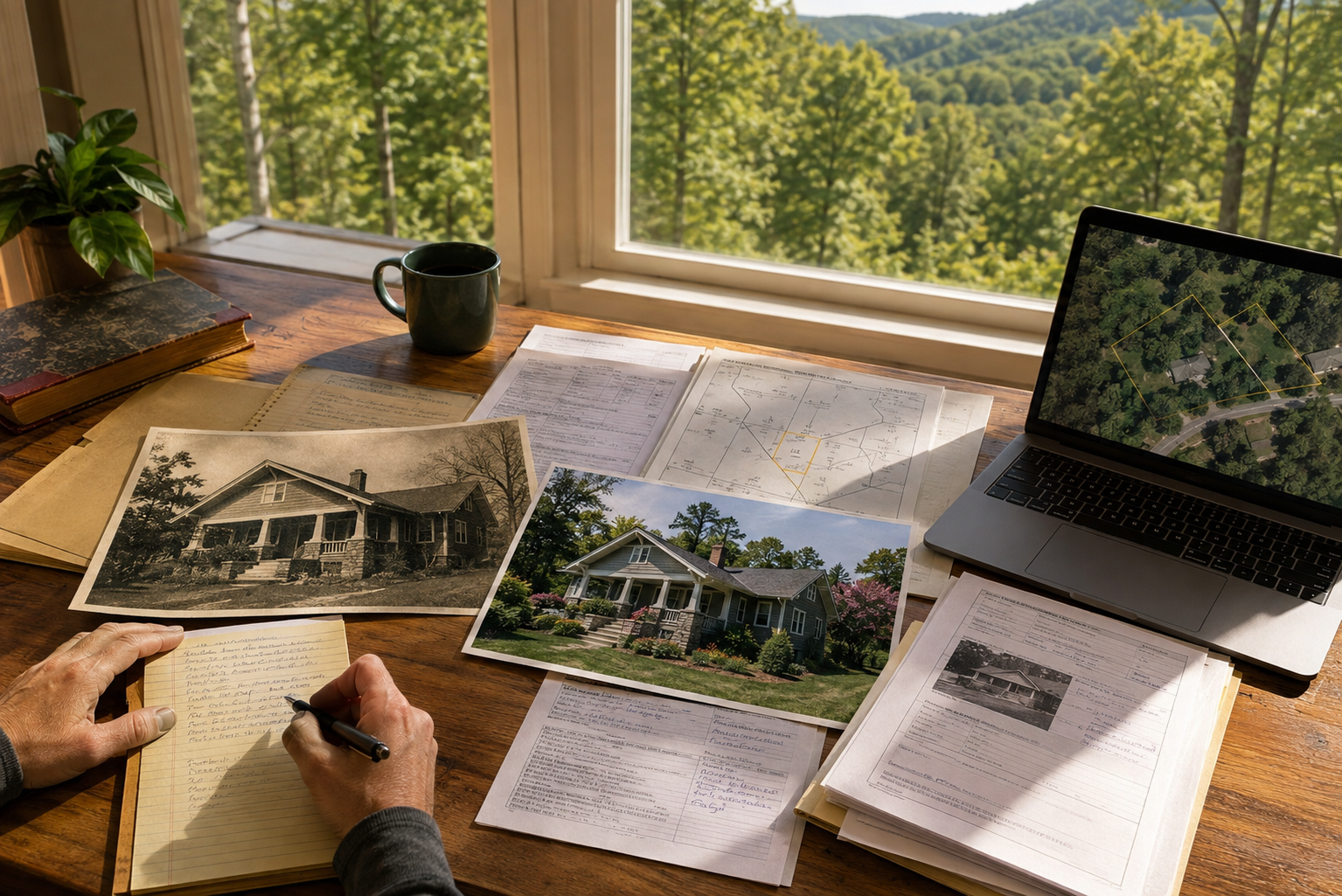
Start With Hendersonville and Henderson County Permit Checks
Permit history is one of the first places I look when a home appears to have changed substantially over time. Permits can help establish when an addition, deck, electrical project, plumbing improvement, HVAC replacement, structural repair, or other significant work entered the official approval process.
This is especially useful with older Hendersonville homes because the age shown in a property record does not necessarily describe every part of the structure. A house could have an original section from one era, a later family room addition, an enclosed porch, a converted garage, and a deck added under completely different owners. The finished product may look seamless today, but those spaces can have very different construction histories.
Know Where to Search for Hendersonville Permits
Jurisdiction matters locally. The City of Hendersonville contracts with Henderson County for building permitting and inspections, while zoning matters within Hendersonville’s jurisdiction are handled through the City’s Community Development resources. Henderson County also separates some historical permit research by date, so researching a property with improvements spanning several decades may involve more than one records system.
I compare whatever permit information is available with the house itself. If the listing describes a substantial addition, I want to see whether the records help explain it. If the seller says the electrical system was updated, I want to understand whether that meant replacing a panel or completing a broader electrical renovation. A permit is not a substitute for a home inspection, but it gives us a documented timeline we can compare with what exists today.
Hurricane Helene repairs add another reason to pay attention to recent permits. Henderson County’s guidance confirms that permits are required for various structural and building system repairs following storm damage. (hendersoncountync.gov) If a property underwent substantial post-storm work, I would want the available permit and repair documentation to be part of the conversation.
Take Unclosed Permits Seriously Without Assuming the Worst
An open or unclosed permit does not automatically mean a home has defective construction. Sometimes work was completed, but the final inspection was never requested. A project’s scope may have changed, or an older record may contain an administrative issue.
What matters to me is understanding why the permit remains unresolved before my buyer inherits the question.
An open permit can potentially become relevant when the buyer later renovates, refinances, works through insurance questions, or eventually sells the property. At that point, tracking down the original owner or contractor may be considerably harder. The source material makes the same practical point: unresolved work can follow the property into future insurance, refinancing, renovation, appraisal, or resale conversations.
Ask for the Paper Trail While the Seller Is Still Available
If I find an unresolved permit, I want to start gathering information rather than immediately drawing conclusions. The seller may have invoices, photographs, contractor details, inspection documents, warranties, engineering reports, or correspondence that explains what happened.
This becomes particularly important when the home has undergone major recent storm repairs. If structural, electrical, plumbing, heating, cooling, or flood-related work was performed after Helene, I would want to understand what was repaired, whether permits were required, what inspections occurred, and whether the work reached final approval.
The goal is simple: resolve as much uncertainty as reasonably possible while the people who know the property’s recent history are still involved in the transaction.
Study Sale History Patterns Instead of Looking at the Last Sale Alone
I also look at how often the property has changed hands. Sale history can be useful, but it needs to be interpreted carefully because people sell homes for perfectly ordinary reasons. Job relocations, retirement, family changes, estates, investment strategies, and financial circumstances can all produce short ownership periods.
Still, if I see several quick sales, I am going to ask why.
Perhaps the home was renovated and flipped. Maybe previous owners relocated unexpectedly. But I also want to consider practical characteristics that may not become obvious during a short showing, such as a steep driveway, private road responsibilities, traffic noise, drainage issues, expensive property maintenance, or insurance considerations.
Henderson County GIS Can Help Fill in the Timeline
Henderson County’s GISWeb is particularly useful because it lets buyers look beyond a basic transaction history. The current system provides parcel information, deed and plat connections, flood information, neighboring parcels, and historical aerial imagery. The uploaded research notes that the live system includes aerial layers reaching back to 1951 and through recent years, making it possible to compare how a property and its surroundings changed over time.
Historical aerial photographs can sometimes reveal when an addition appeared, when land was cleared, how a driveway changed, or when a detached structure was built. They can also show development on neighboring land that may have altered drainage or the character of the area.
I do not use short ownership cycles to scare buyers. I use them as prompts. One quick resale may mean very little. Several quick resales combined with repeated drainage work, difficult access, or other recurring concerns deserve a closer look.
Read the North Carolina Seller Disclosure Carefully
Seller disclosures are important, but I never treat them as a substitute for independent investigation.
The disclosure tells us what the seller represents about the property within the applicable disclosure framework. It does not mean a professional has inspected every component of the home. A seller may also have limited knowledge, particularly when the property is part of an estate, was used as a second home, was recently purchased and renovated, or contains improvements completed long before the current owner arrived.
That is why I read the disclosure alongside permits, public records, visible property conditions, and eventually the inspection.
Words Like “Updated” and “Repaired” Need More Context
If I see “roof leak repaired,” I want to understand when the leak occurred, what caused it, who completed the repair, and whether related damage was addressed. If the disclosure mentions water in a crawlspace or basement, I want to know whether the source was plumbing, groundwater, surface runoff, roof drainage, or an actual flood event.
Likewise, “updated electrical” could mean anything from a replaced breaker panel to a much broader rewiring project. “Plumbing replaced” might refer to one failed section rather than the entire plumbing system.
In Hendersonville, I pay particularly close attention to disclosure information involving drainage, grading, retaining walls, foundations, basements, crawlspaces, private roads, wells, septic systems, and storm damage. Our terrain matters because water does not need a nearby creek to become a property issue. Runoff can come from uphill land, roads, neighboring development, roofs, or poorly functioning drainage.
When repairs are disclosed, I like documentation. Permits, invoices, warranties, photographs, engineering reports, and contractor records can turn a vague statement into something much easier to evaluate.
Check FEMA Flood Reports and Then Study the Actual Property
Flood information should be part of the research process for a Hendersonville home, particularly after the severe weather Western North Carolina has experienced.
FEMA mapping is a logical starting point because it helps identify mapped flood hazards and can affect flood insurance requirements. Hendersonville also participates in the National Flood Insurance Program and regulates development within identified flood hazard areas.
But I never want a buyer to stop after checking the map.

A FEMA Map Cannot Show Every Water Problem
A property can sit outside a mapped Special Flood Hazard Area and still have water-related concerns. Yard saturation, crawlspace moisture, runoff from higher ground, erosion, overflowing roadside drainage, a washed-out driveway, or an undersized culvert may have little to do with whether the house sits inside a FEMA-mapped high-risk zone.
During a showing, I look at the entire lot. Where is the house relative to the road? Which direction does the land slope? Where do gutters and downspouts send water? Are there retaining walls? Do I see erosion, sediment deposits, drainage pipes, pumps, newly disturbed soil, or extensive waterproofing?
Road access matters too. Hendersonville’s flood preparedness information warns that major rain events can affect local roadways, which means the practical route to a property deserves consideration alongside the structure itself.
Current Hendersonville Flood Projects Add Useful Context
One current project worth knowing about is Hendersonville’s Lower Mud Creek Floodplain Restoration project. The City describes work involving floodplain reconnection, stream restoration, Mud Creek bank stabilization, and wetland and riparian improvements, with the current project information estimating completion in early 2027.
That does not mean a home near a flood project automatically has a flooding problem. What it demonstrates is how important watersheds and larger drainage systems are in Hendersonville. I want to understand both the FEMA designation for the individual parcel and what is happening with water around the broader property.
Check Zoning Changes Before Assuming the View Will Stay the Same
The wooded property behind a house can be one of the reasons you fall in love with it. The important thing to remember is that unless you are purchasing that land too, those trees are not part of what you own.
That is why zoning belongs in the home history conversation. We are not only researching what happened to the property before you arrived. We also want to understand what local rules and planning decisions could allow nearby.
Hendersonville’s Gen H 2045 Plan Gives Buyers a Look at Future Direction
Hendersonville adopted its Gen H 2045 Comprehensive Plan in August 2024. The plan establishes a long-range framework for issues such as growth, housing, transportation, conservation, and future land use.
A comprehensive plan does not mean a specific project has been approved for every parcel. It does, however, help buyers understand the City’s broader planning direction.
I also want to look at current zoning and nearby planning applications when privacy, traffic, views, or neighborhood character are major reasons for buying a particular home. Rezoning, subdivisions, annexations, and redevelopment can gradually change an area.
The opposite can be true as well. A buyer who values walkability and nearby services may see appropriate future development as an advantage.
A Hendersonville Mailing Address Does Not Answer Every Zoning Question
Before researching zoning, I confirm which jurisdiction controls the property. A Hendersonville mailing address does not necessarily mean the home is governed by the City of Hendersonville for every planning issue. Depending on location, the applicable rules and government authority can differ.
Historic properties can introduce another layer. If a home falls within a locally regulated historic district, certain exterior improvements may require additional review. That becomes important if your reason for buying an older home includes plans for additions, windows, porches, siding, roofing, or other exterior changes.
Likewise, I would never assume a large lot can automatically be subdivided or that a detached building can automatically become another residence. If a particular future use is important to your purchase decision, I want it verified with the appropriate local authority before you rely on it.
Put These Six Pieces Together Before Making the Offer
No single database can tell us whether a Hendersonville home is a good purchase. The useful picture emerges when we compare the information.
I want to see whether permit checks support the renovations we can see. I want to understand any unclosed permits before they become the buyer’s responsibility. I study sale history patterns for questions worth investigating rather than assuming every quick sale signals a problem. I compare the seller disclosure with the records and physical condition of the property. I use FEMA flood information as a starting point and then look closely at the actual terrain and drainage. Finally, I review zoning and planning changes when future development could affect the lifestyle the buyer expects.
This does not mean every Hendersonville home needs a flawless paper trail. Older properties rarely come with perfect documentation for everything that happened over several generations of ownership. What matters is knowing what we can verify, understanding what remains uncertain, and deciding whether that uncertainty deserves additional professional investigation.
A home with a long history can still be an excellent purchase. In fact, some of the character people love about Hendersonville comes from established neighborhoods, mature landscapes, older architecture, and homes that have evolved thoughtfully over time. I simply want my clients to understand that history before they make the property part of their own.
When the permits, ownership timeline, disclosure, flood information, and zoning story all make sense together, you can make an offer with a much clearer understanding of what you are actually buying. And when something does not line up, we have identified the question while there is still time to get an answer.