

When buyers walk into a home, the things that usually catch their attention are easy to understand. A beautiful kitchen, a cozy fireplace, a mountain view, or a backyard with mature trees can create that immediate feeling of “this could be the one.” I completely understand that excitement because buying a home is a very personal decision.
But after years of helping clients navigate the home-buying process, I’ve learned that some of the most important details are the ones that are easiest to miss. Water movement, drainage, foundation moisture, and flood risk are not always visible during a sunny afternoon showing, but they can have a major impact on how a home feels and performs for years after closing.
This is something I always talk about with buyers looking in Hendersonville because our area has a unique landscape. We are surrounded by rolling hills, mountain views, wooded properties, creeks, and changing elevations. Those features are part of what makes Western North Carolina such a special place to live, but they also mean water behaves differently here than it does in flatter areas.

Not sure where to start? Neither were most of our clients.
A home built on a hillside lot may handle rainfall very differently than a property located in a lower area near a creek or valley. A beautiful yard may hide drainage challenges that only appear after several days of heavy rain. A finished basement may look perfect during a showing but reveal signs of moisture history when you know what to look for.
I’ve seen buyers fall in love with homes that seemed perfect at first but later discovered that water management was one of the biggest factors affecting the property. That does not mean those homes were automatically bad purchases. Many water-related issues can be repaired or managed. The important thing is knowing what you are buying before you make that commitment.
When I walk through a home with my clients, I’m not just looking at the finishes and updates. I’m thinking about how the property interacts with the environment around it.
- Where does rainwater naturally flow?
- Does the grading direct water away from the foundation?
- Are gutters and downspouts working properly?
- Does the crawl space show signs of moisture control?
- Has the homeowner taken steps to protect the structure from Hendersonville’s seasonal weather?
These questions help buyers make informed decisions instead of discovering problems after they have already moved in.
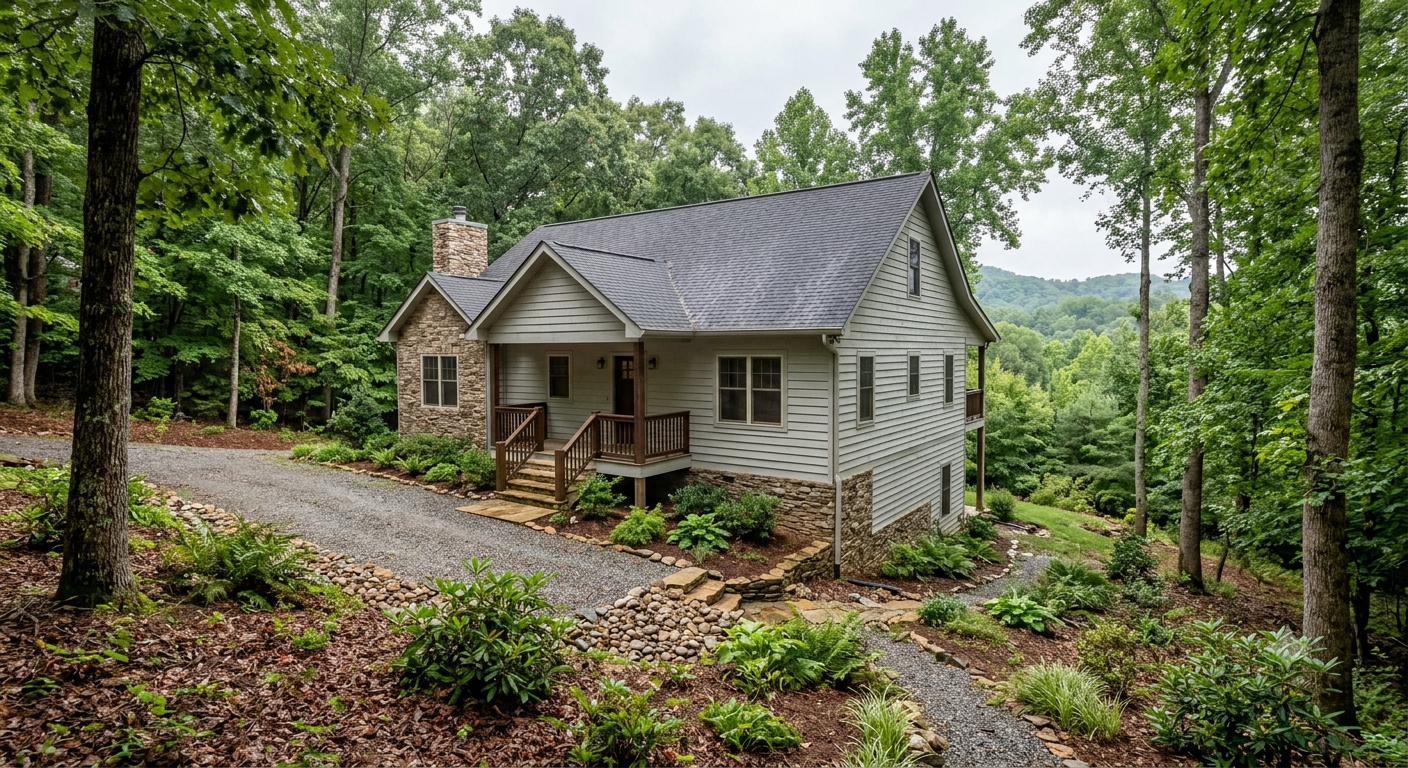
How Hendersonville’s Terrain Shapes Water Behavior Around Homes
One of the biggest advantages of living in Hendersonville is the natural beauty that surrounds us. The mountains, elevation changes, and wooded landscapes create some of the most desirable settings in the region. At the same time, the terrain plays an important role in how homes handle water.
Unlike flat areas where drainage patterns may be more predictable, Hendersonville properties often have unique water flow patterns based on their location, slope, and surrounding landscape.
A home on a hillside may experience runoff moving quickly downhill during a major storm. A property positioned lower on the landscape may collect water naturally from surrounding areas. Even homes that appear close together can have completely different drainage situations depending on how the land was shaped before construction.
This is why I always encourage buyers not to judge a property only by what they see during a short showing. A dry yard today does not necessarily tell the full story. The better question is how that property performs during real weather conditions.
Hendersonville receives significant rainfall throughout the year, and periods of heavy rain can put drainage systems to the test. Water will always follow gravity, and if a property does not have a clear path for runoff, it will eventually find another one.
That may mean water collecting near the foundation, entering a crawl space, creating erosion around landscaping, or putting additional pressure on retaining walls.
When I’m evaluating a property with buyers, I like to think about the entire site rather than just the house itself. The land, drainage systems, foundation, gutters, and landscaping all work together. When those pieces are designed and maintained properly, they help protect the home. When one part fails, the effects can spread.
The Importance of Proper Grading Around the Home
Grading is one of the most overlooked parts of a property because it is something buyers rarely notice during their first visit.
Simply put, grading refers to how the ground around the home is shaped and sloped. Ideally, the land should encourage water to move away from the foundation instead of allowing it to collect near the structure.
Proper grading quietly protects a home every day. Rain falls, water moves away, and the foundation stays better protected from unnecessary moisture exposure.
The problems begin when grading changes over time or was never properly designed in the first place.
In Hendersonville, this can happen for several reasons. Landscaping improvements, patios, walkways, retaining walls, driveway changes, or years of soil settling can all affect the way water moves across a property.
I’ve walked properties where the landscaping looked beautiful, but the slope of the yard directed rainfall directly toward the home. These situations can be difficult to recognize because everything may look well-maintained on the surface.
During a showing, I pay attention to small details that can provide clues. I look at whether the ground slopes away from the foundation, whether downspouts are moving water far enough away from the home, and whether there are areas where soil appears consistently damp or eroded.
These observations are not a replacement for a professional inspection, but they help start the right conversations early.
A buyer does not need a property with a perfectly flat lot or a completely maintenance-free landscape. Many of Hendersonville’s most beautiful homes are built on interesting terrain. The goal is to understand whether the property has systems in place to manage that terrain effectively.
Why Water Always Finds the Weakest Point
One thing I always remind my clients is that water is patient. It does not need a dramatic opening or obvious damage to create problems. It simply looks for the easiest path.
That path may be a small foundation crack, an aging seal around a basement window, a poorly positioned downspout, or a drainage area that was never properly designed.
At first, these issues may seem insignificant. A little moisture after a storm or a small damp area in a crawl space may not feel urgent. However, repeated exposure over time can create much larger concerns.
Water-related problems often develop slowly. Materials absorb moisture. Wood can deteriorate. Mold can develop. Soil can shift. Foundation issues can become more noticeable.
This is why I encourage buyers to think about potential risk, not just current appearance.
A home that looks perfect today may still need attention if the conditions around it allow moisture to become a recurring issue. On the other hand, a home with a small drainage concern may still be a wonderful purchase if the buyer understands the situation and has a realistic plan for addressing it.
The key is awareness.
When buyers understand how water interacts with a property, they can make decisions based on facts rather than surprises.
Basement and Crawl Space Conditions That Reveal Hidden Risks
Some of the most honest information about a home is often found below the main living areas.
Basements and crawl spaces are not always the most exciting parts of a showing, but they can reveal important details about how a home has handled moisture over time.
I always encourage my buyers to look carefully at these spaces because they tell a story. They show whether the property has been properly maintained, whether previous owners addressed moisture concerns, and whether there may be issues worth investigating further.
In Western North Carolina, below-grade spaces deserve extra attention because of our climate and terrain. Rainfall, humidity, slopes, and changing soil conditions all influence how moisture interacts with a home.
A dry, well-maintained basement or crawl space can be a great sign. A damp or neglected one deserves a closer look before moving forward.
Basement Water Intrusion and Long-Term Implications
Basements can be wonderful features in Hendersonville homes. They provide additional living space, storage, workshops, and flexibility for homeowners.
However, because basements are below ground level, they naturally interact with surrounding soil and groundwater.
During heavy rainfall, water in the soil can create pressure against foundation walls. Over time, that pressure can contribute to moisture intrusion if drainage systems are not working properly.
Some warning signs are obvious, such as standing water or active leaks. Others are much more subtle. A musty smell, staining on concrete walls, peeling paint, or signs of previous repairs can indicate that moisture has been present at some point.
I always tell buyers that these signs do not automatically mean they should walk away from a home. Many properties have manageable moisture issues. The important thing is understanding the cause and the potential solution.
A professional home inspection can help determine whether the issue is minor maintenance or something requiring more significant attention.
For buyers, the goal is not finding a home that has never experienced a single drop of water. The goal is to find a home where water has been properly managed.
Crawl Spaces and Moisture Management Challenges
Crawl spaces are one of the areas I pay especially close attention to when helping buyers evaluate homes in Hendersonville. They are often easy to overlook because they are hidden away, but they play a major role in the overall health and condition of a property.
Many homes throughout Hendersonville and the surrounding Western North Carolina area have crawl spaces, especially older homes and properties built on sloped lots. Because of our terrain, builders have often used crawl space foundations as a practical way to work with elevation changes while creating a stable structure.
The challenge is that crawl spaces are constantly connected to the conditions around them. Moisture from the soil, humidity in the air, and water movement around the property can all affect these areas over time.
When I enter a crawl space during a showing or inspection process, I’m looking for signs that moisture has been managed properly. A clean vapor barrier, dry support beams, properly directed drainage, and evidence of maintenance are all positive indicators.
Soil, standing water, musty odors, sagging insulation, wood deterioration, or visible mold growth are signs that deserve additional investigation.
One of the biggest misconceptions I hear from buyers is that because a crawl space is not part of the living area, it is not a major concern. In reality, what happens beneath the home can affect many other parts of the property.
Moisture in a crawl space can contribute to damaged floor systems, structural concerns, unpleasant odors, and increased indoor humidity. Since air naturally moves throughout a home, conditions below the house can eventually influence the comfort and air quality inside the living spaces.
This is why I always encourage buyers to look at a home as one connected system. The roof, gutters, grading, foundation, crawl space, and drainage solutions all work together.
A property does not need to be perfect to be the right home. Many Hendersonville properties have unique characteristics because of their age, location, and mountain setting. The important part is understanding what those characteristics mean and whether the home has been cared for properly.
Flood Zones, FEMA Maps, and Insurance Considerations
Flood risk is another important factor Hendersonville buyers should understand before purchasing a home.
When people hear the word “flood,” they often imagine homes located directly beside rivers or areas with obvious standing water concerns. While those locations can carry higher risk, flooding and water accumulation can occur in many different situations.
Hendersonville’s landscape includes streams, creeks, valleys, and areas where runoff naturally collects. Heavy rainfall combined with changing terrain can create drainage challenges even in areas that may not immediately appear vulnerable.
I always encourage buyers to look beyond whether a property has flooded in the past. A home’s history matters, but future conditions matter too.
Changes in development, drainage patterns, weather events, and surrounding properties can all influence how water behaves.
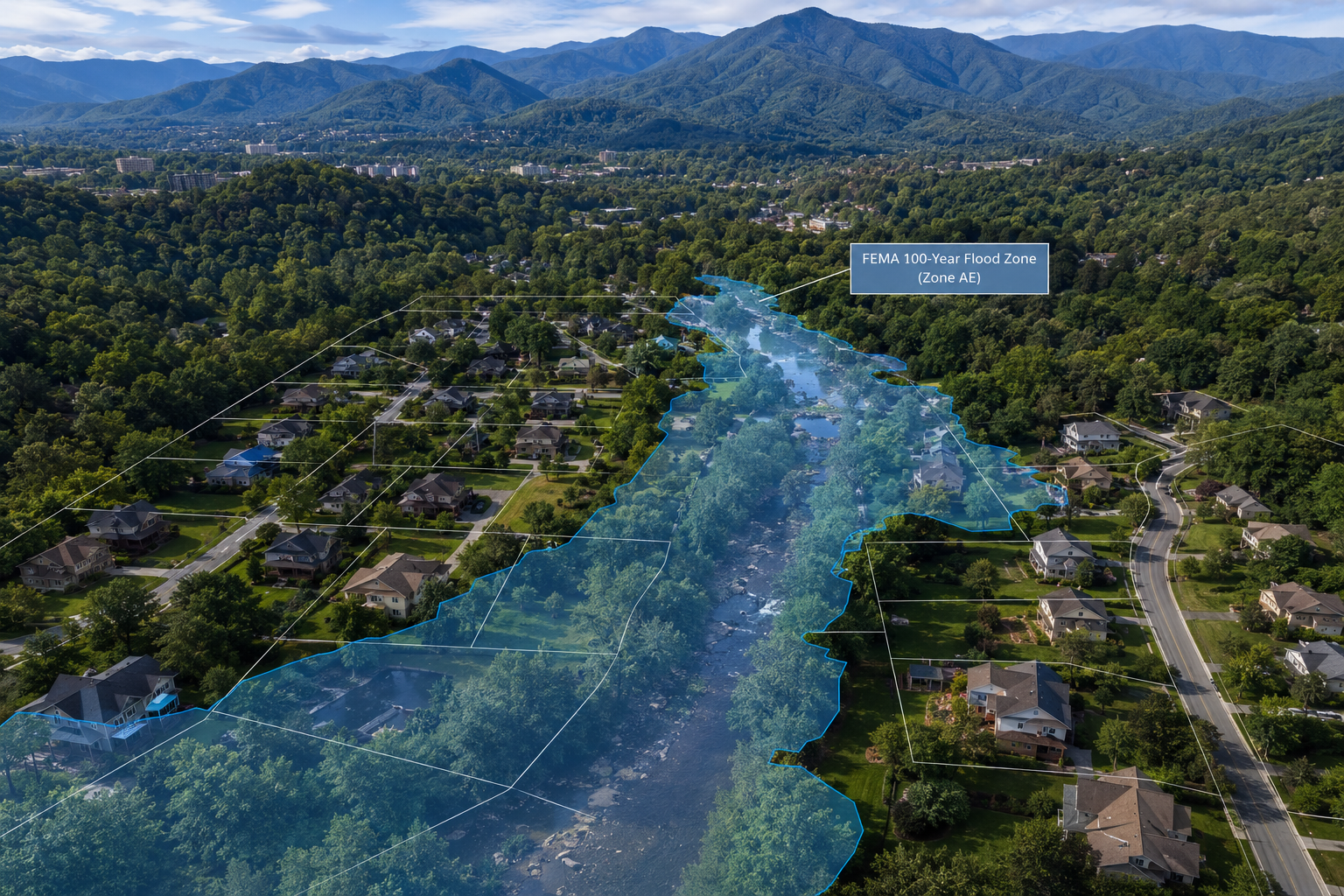
How FEMA Flood Maps Influence Property Risk
FEMA flood maps are an important resource when evaluating a property’s potential flood exposure.
These maps use information such as elevation, historical flooding patterns, and studies of water movement to identify areas that may have increased flood risk.
For buyers, FEMA maps can provide valuable insight, especially when purchasing near waterways or in lower-elevation areas.
However, I always remind clients that a map is only one piece of the puzzle.
A property outside a designated flood zone can still experience drainage problems due to grading, clogged drainage systems, nearby construction, or unusual weather events. Likewise, a property located near a mapped area may have strong drainage systems and effective protections already in place.
That is why I recommend combining FEMA information with an actual evaluation of the property itself.
During the buying process, I encourage clients to ask questions about the property’s history, review available records, and discuss insurance requirements with their provider.
Knowledge is what allows buyers to make confident decisions.
Reviewing FEMA Flood Reports and Henderson County Flood Data Before Buying
When I’m helping buyers purchase a home in Hendersonville, I always recommend looking beyond the simple question of “Is this property in a flood zone?” That question is important, but it does not tell the whole story.
Flood risk information comes from several different sources, and understanding the actual reports behind the maps can help buyers make a much more informed decision.
The first document I encourage buyers to review is the FEMA Flood Insurance Study (FIS) for Henderson County, North Carolina. This is the technical report FEMA uses to support its Flood Insurance Rate Maps (FIRMs). The study includes the engineering information used to identify flood hazards, including studied waterways, floodplain boundaries, flood elevations, and areas where flooding may occur during a major storm event.
For Henderson County, the current FEMA Flood Insurance Rate Maps available through the county are based on the 2008 Flood Damage Prevention Flood Insurance Rate Map study, with individual map panels carrying effective dates of October 2, 2008, and October 2, 2009, depending on the panel location.
That detail matters because buyers should know exactly which FEMA panel applies to the property they are considering. Henderson County maintains a FEMA Flood Insurance Rate Map Index that allows property owners and buyers to identify the correct map panel associated with a location.
When I review flood information with buyers, I look at more than just the flood zone designation. I want to understand the conditions behind that designation.
Some of the key details I pay attention to include:
FEMA Flood Insurance Rate Map Panel Information
The FEMA map panel is the specific section of the county’s flood map where the property is located. These panels show areas such as:
- Zone AE areas, which are Special Flood Hazard Areas where FEMA has studied flood elevations and where flood insurance requirements may apply for federally backed loans.
- Floodways, which are areas FEMA identifies as carrying the main channel of floodwaters and typically have stricter development restrictions.
- Other flood hazard areas identified through FEMA mapping.
Henderson County’s GIS flood data also includes FEMA flood zones, FIRM panels, and flood-related mapping layers used for county planning and property research.
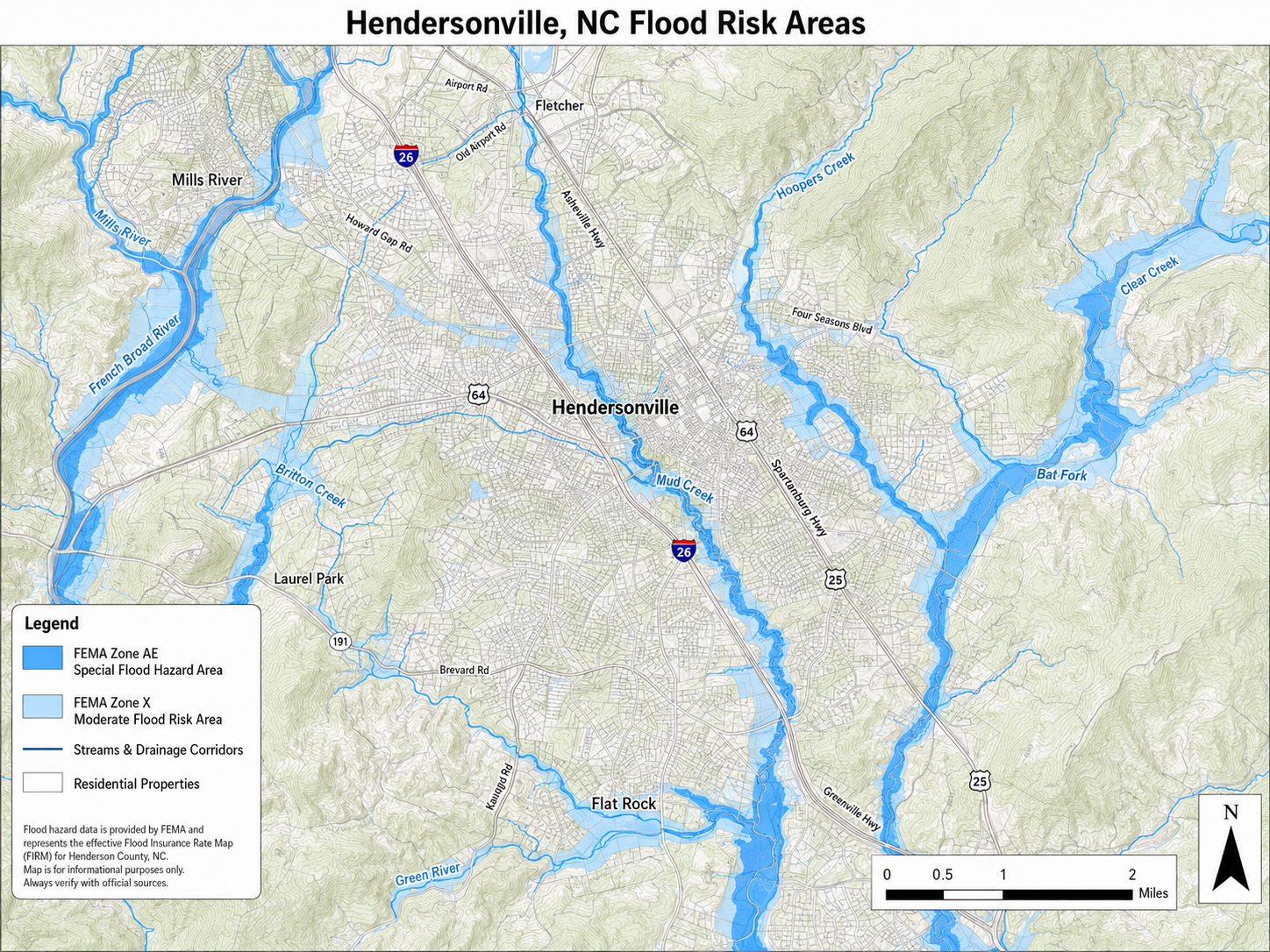
FEMA Flood Insurance Study Information
The Flood Insurance Study is especially helpful because it explains the “why” behind the map.
For a buyer in Hendersonville, this information can provide insight into whether a property’s flood risk is connected to nearby streams, mapped floodplains, drainage corridors, or other studied water features.
This is especially important in our area because Hendersonville properties are shaped by mountain terrain. A home near a creek or lower elevation area may experience very different water movement compared with a home on higher ground, even if both properties are located within the same general neighborhood.
I always remind buyers that FEMA studies are valuable tools, but they are not a substitute for evaluating the actual property.
A FEMA map may identify regulated flood risk, but it does not always capture every drainage concern caused by heavy rainfall, hillside runoff, poor grading, or changes to surrounding land.
Henderson County GIS and Advisory Flood Data
Another resource I encourage buyers to review is Henderson County’s GIS flood information and North Carolina’s advisory flood data.
Henderson County maintains GIS flood layers that include FEMA flood zones and related flood information. The county also provides access to North Carolina’s Advisory Flood Data resources, which were created because recent flooding events have shown that meaningful flood risk can sometimes exist outside traditional regulatory floodplain boundaries.
This is an important point for Hendersonville buyers.
A property does not have to be located directly inside a FEMA flood zone to experience water-related challenges. Heavy rainfall, mountain runoff, undersized drainage systems, and changing conditions around a property can all contribute to flooding or moisture issues.
That is why I always encourage buyers to combine FEMA information with:
- The home inspection report
- Crawl space and basement evaluations
- Grading observations
- Drainage assessments
- Seller disclosures
- Insurance conversations
How I Use FEMA Reports During the Home Buying Process
During due diligence, my goal is always to help buyers understand the full picture before they commit to a property.
If a home is located near a mapped flood area, I want my clients to understand what created that designation and what it means for ownership. If a home is outside a FEMA flood zone, I still want buyers to think about drainage, slope, and water movement because those issues can exist anywhere.
For Hendersonville buyers, reviewing FEMA reports is not about creating unnecessary concern. It is about being prepared.
A home is one of the largest investments most people make, and understanding the official flood data behind a property gives buyers another layer of confidence.
The question I always want my clients to answer is not simply:
- “Is this home in a flood zone?”
- The better question is:
- “How has this property handled water in the past, and how prepared is it for the future?”
- That is the information that helps buyers make smarter decisions before closing.
The Long-Term Cost of Flood Insurance
Flood insurance is another important consideration when evaluating the true cost of owning a home.
Standard homeowners insurance typically does not cover flood damage, which means buyers may need a separate flood insurance policy depending on the property’s location and risk factors.
The cost of flood insurance can vary based on several factors, including elevation, flood zone classification, coverage amount, and the property’s specific characteristics.
I always encourage buyers to look beyond the purchase price when budgeting for a home. The monthly mortgage payment is only one part of ownership. Insurance, maintenance, utilities, taxes, and future repairs all play a role.
Understanding these costs early helps buyers avoid surprises after closing.
For many people, Hendersonville is worth it because of everything the area offers: beautiful scenery, community, outdoor recreation, and a wonderful quality of life. My job is to help buyers understand the property fully so they can enjoy those benefits with confidence.
Drainage Systems and Site Engineering Considerations
A good drainage system is one of the quiet protectors of a home. When it works properly, most homeowners rarely think about it.
Gutters collect rainfall. Downspouts move water away from the foundation. Grading directs runoff. Drainage systems help prevent water from settling where it can cause damage.
When these systems fail, water does what it naturally does: it looks for another path.
That path may lead toward the foundation, crawl space, basement, or areas where erosion can occur.
In Hendersonville, drainage planning is especially important because of the area’s terrain. Homes built on slopes often require thoughtful solutions to manage runoff effectively.
During a home evaluation, I pay attention to whether drainage systems appear intentional and maintained. Small details can make a big difference over time.
The Hidden Cost of Ignoring Water-Related Issues
Water problems rarely remain the same forever.
A small drainage concern today can become a much larger repair tomorrow if the source is not addressed. Moisture can affect foundations, wood structures, flooring systems, and indoor comfort.
This is why I encourage buyers to view water management as part of the home’s long-term value.
A property is not just the finishes you see when you walk through the door. It is also the systems working behind the scenes that protect your investment.
Understanding those systems helps buyers make decisions with confidence.
The Role of Due Diligence in Protecting Your Investment
Buying a home is one of the biggest decisions most people will ever make, and due diligence is the process that helps you understand what you are truly purchasing.
Drainage, grading, crawl spaces, sewer lines, flood risks, and moisture concerns may not be the most exciting topics during the home search, but they are some of the most important.
I always want my clients to feel informed and prepared. My goal is not just to help someone find a house they love. It is to help them find a home they can feel confident owning.
Hendersonville offers incredible opportunities for buyers who appreciate mountain living, beautiful landscapes, and unique properties. Understanding how water interacts with those properties is simply part of making a smart decision in Western North Carolina.
When you take the time to ask the right questions, complete the right inspections, and understand the land beneath the home, you are giving yourself the best possible chance for a successful purchase.
A home should be a place where you feel comfortable, protected, and excited about the future. Careful evaluation before closing helps make that possible.